AdaThinkV: Adaptive Thinking for Token-Efficient Video Reasoning

Jingqi Tian1*, Haoji Zhang1*, Lin Chen2*, Hongbo Jin3, Haonan Xu2, Tianrui Zhu1, Xingming Shui1, Shilin Ma1, Wenjing Yang2, Yansong Tang1✉
1Tsinghua University, 2Alibaba Group, 3Peking University
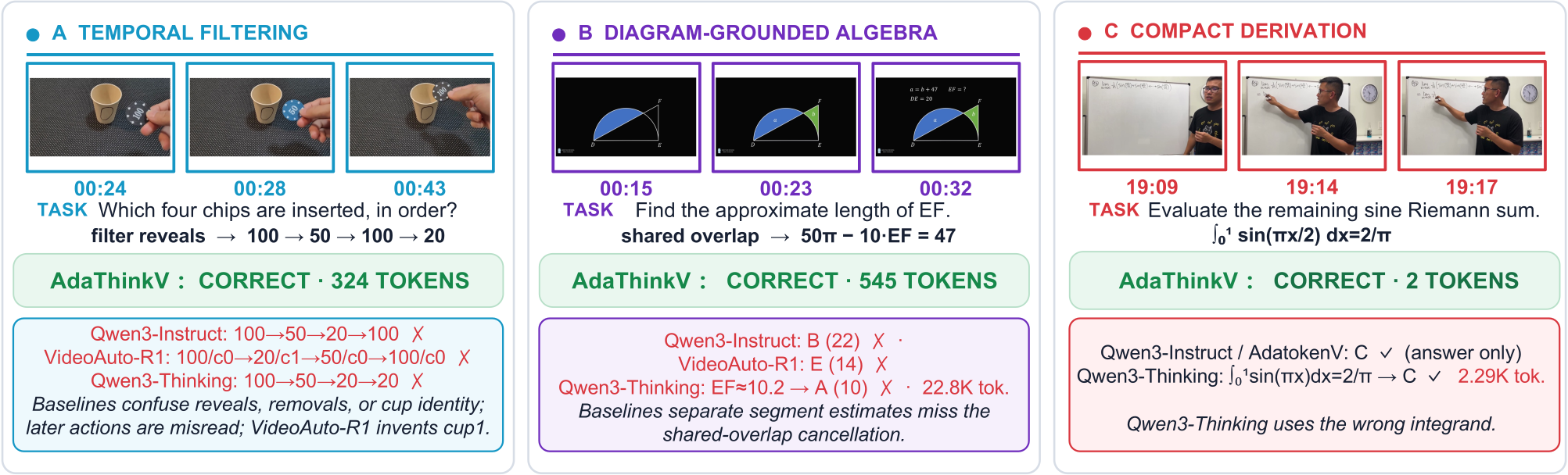
AdaThinkV motivation and qualitative comparison
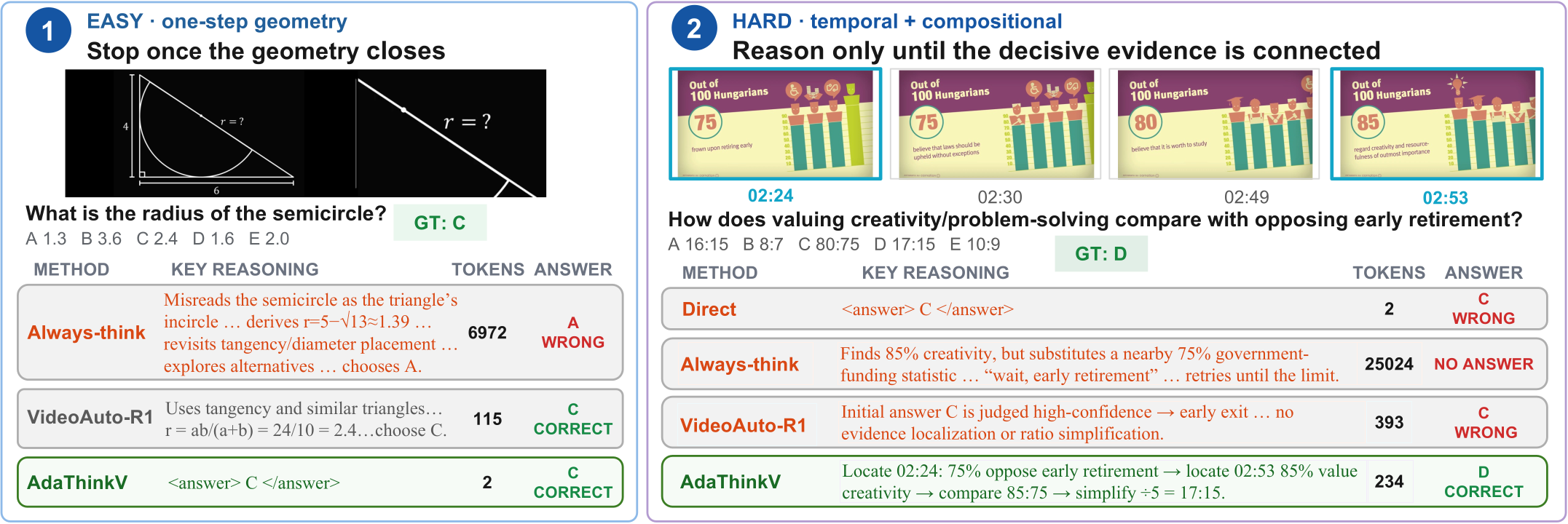
Why does response-mode selection matter? Always reasoning can overcomplicate simple questions, while confidence routing can stop before collecting evidence needed for compositional reasoning. AdaThinkV learns when explicit reasoning is worth its cost.

TL;DR

AdaThinkV teaches a video MLLM to choose between direct answering and explicit reasoning for each question. ThinkGain estimates whether the accuracy benefit of reasoning justifies its extra output length, while Variance Recovery Policy Optimization (VRPO) expands difficult rollout groups to recover useful reinforcement-learning signals.

40.79
Mean accuracy
257.20
Average output tokens
+2.98
Accuracy vs. strongest adaptive baseline
-22.7%
Output tokens vs. that baseline

Abstract

Chain-of-thought reasoning can improve performance on difficult video questions but often wastes decoding tokens on simple ones. AdaThinkV is an adaptive framework for video reasoning that learns whether to reason explicitly without offline difficulty labels, manually tuned confidence thresholds, or an external router. During reinforcement learning, it samples matched rollouts in explicit-reasoning and direct-answering modes. ThinkGain estimates the prompt-level utility of explicit reasoning by balancing its accuracy gain against additional response length, supervising both conditional generation and autonomous mode selection. For difficult prompts, VRPO retains and progressively expands unsuccessful, low-dispersion rollout groups to recover informative signals from prompts that are difficult yet solvable. At inference, AdaThinkV selects a response mode and generates the response in a single autoregressive sequence.

Method

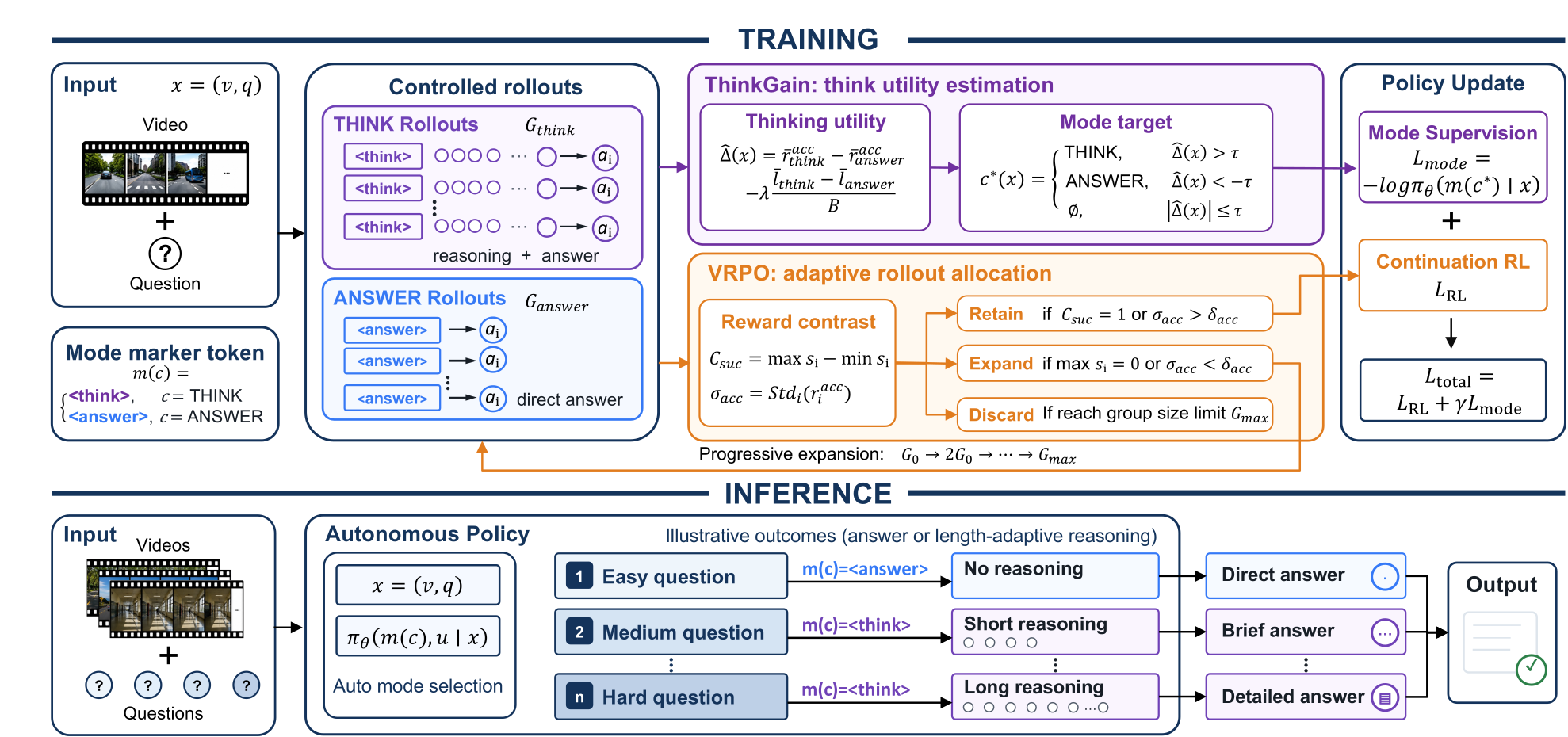
AdaThinkV training and inference pipeline
AdaThinkV training and inference pipeline. ThinkGain constructs mode supervision from prompt-matched THINK/ANSWER branches. VRPO progressively allocates more rollouts to groups with weak reward contrast. At inference, the model emits a mode marker and response in one autoregressive sequence.

ThinkGain

Measures the conditional net utility of explicit reasoning: whether its prompt-level accuracy improvement is worth the additional response length.

VRPO

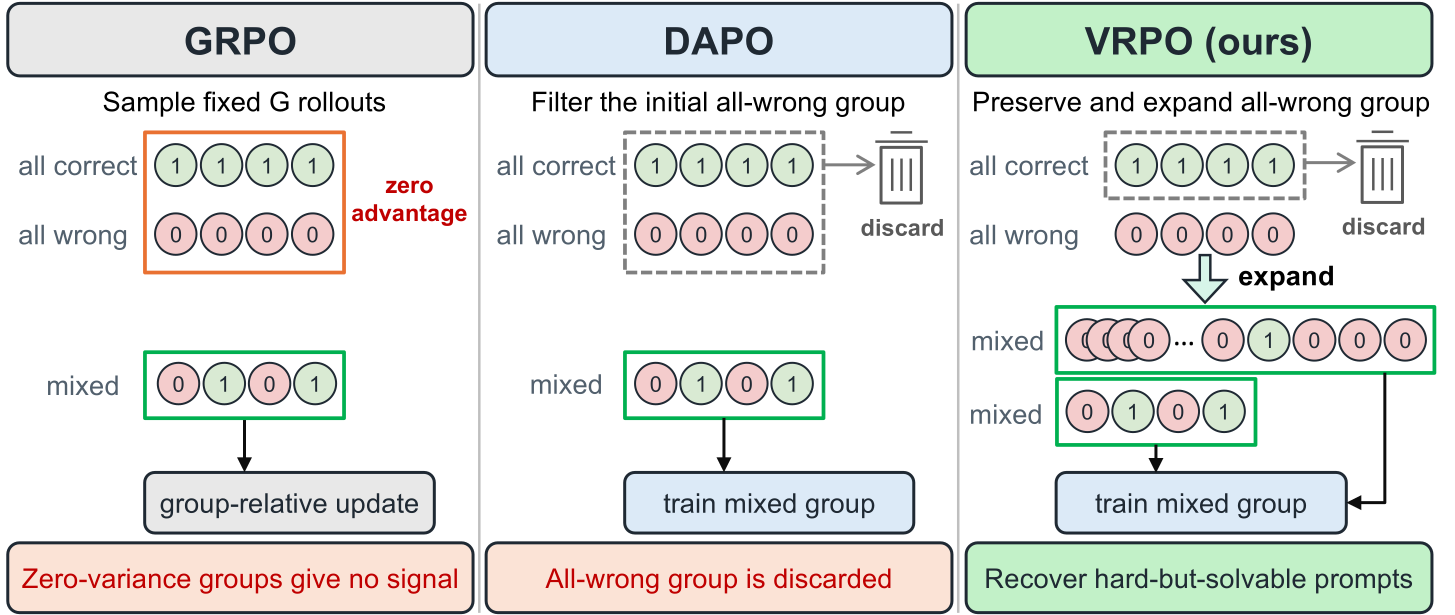
Retains and expands difficult all-unsuccessful groups, broadening exploration until the policy recovers informative reward variation.

Single-pass inference

Selects direct or explicit reasoning without an external router, confidence threshold, or preliminary answer.

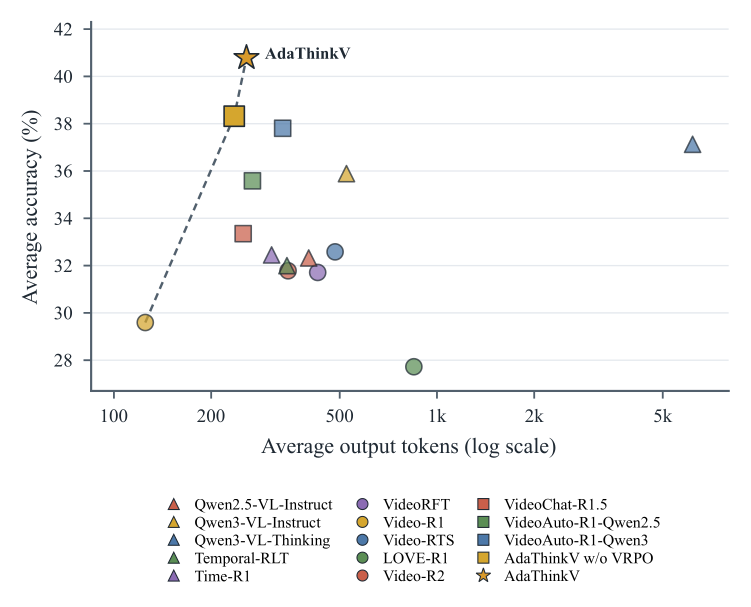
Accuracy–Token Trade-off

Accuracy and output-token Pareto frontier

AdaThinkV advances the empirical Pareto frontier across the unified video-reasoning evaluation suite.

ModelModeAccuracyTokens
Qwen3-VL-8B-ThinkingThink only37.136184.98
VideoAuto-R1-Qwen3Auto37.81332.93
AdaThinkV w/o VRPOAuto38.32235.73
AdaThinkVAuto40.79257.20

Variance Recovery

Dynamic sampling and VRPO rollout allocation comparison
Dynamic sampling versus VRPO. Dynamic sampling discards zero-variance groups and resamples fresh prompts. VRPO keeps the difficult group and expands it progressively, preserving evidence while increasing the chance of finding successful trajectories.

Qualitative Case Study

AdaThinkV qualitative video-reasoning case study
AdaThinkV uses explicit reasoning when temporally separated evidence must be organized, while avoiding unnecessary long-form reasoning for simpler questions.

Citation

@article{tian2026adathinkv,
  title={AdaThinkV: Adaptive Thinking for Token-Efficient Video Reasoning},
  author={Tian, Jingqi and Zhang, Haoji and Chen, Lin and Jin, Hongbo and Xu, Haonan and Zhu, Tianrui and Shui, Xingming and Ma, Shilin and Yang, Wenjing and Tang, Yansong},
  journal={arXiv preprint},
  year={2026}
}